
Recent developments in intensive agriculture, though contributed immensely towards surplus food, caused degradation of fertile land. Recently, the problem of micronutrient deficiencies has increased markedly due to intensive cropping, high-yielding varieties, irrigation, greater use of chemical fertilizers, topsoil erosion, leaching, liming, and decreased use of farmyard manure. It is realized that crop productivity is being adversely affected by these deficiencies. Micronutrients are required in minute quantities, yet are vital to plant growth; they improve general plant condition and act as catalysts in organic reactions. Direct application of inorganic micronutrients can cause toxic effects, hence chelated forms are recommended for better yields. Chelating agents protect metal ions from unfavorable chemical reactions, increasing their availability. While strong synthetic chelating agents are expensive, natural organic agents such as polyflavonoids, lignosulfonates, humic and fulvic acids, amino acids, glutamic acids, and polyphosphates also help in translocating micronutrients.
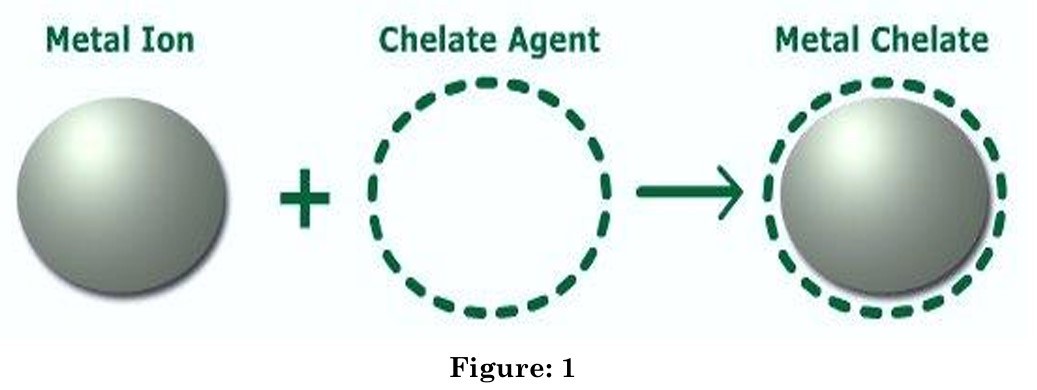
The word “chelate” is derived from the Greek word “chele”, meaning “lobster’s claw”.
The ligand that binds to the metal nutrient ion is encircled by the larger organic molecule (the claw), usually called a ‘chelator’ or ‘chelant’.
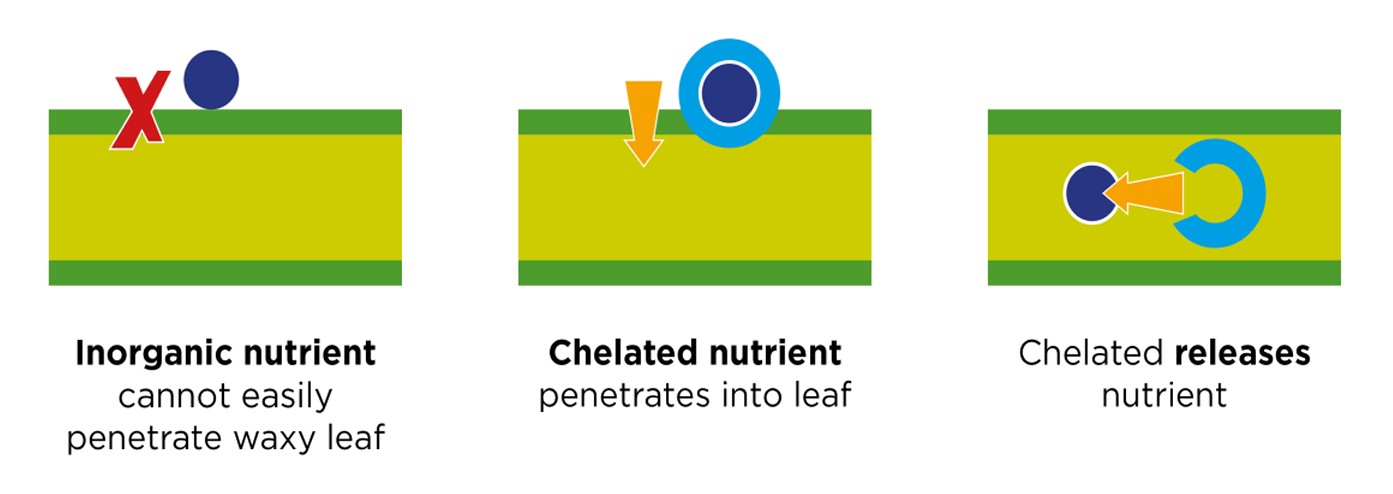
In fertilizer technology, chelate refers to inorganic nutrients enclosed by an organic or synthetic molecule. Chelates may be applied as foliar spray or banded.
Types of Chelate
- Synthetic Chelates:
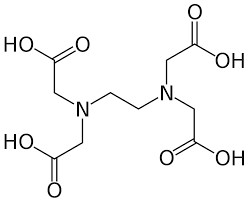
.EDTA (Ethylene di-amine tetra-acetic acid): The most common synthetic chelating agent used for both soil and foliar applications. It is the dominant chelating agent in most chemically manufactured fertilizers. EDTA is considered a foreign compound to plants and is not absorbed; instead, the iron element is absorbed by the plant, and the chelating agent returns to the solution to chelate other positively charged elements. EDTA has 4 bonding sites and forms a relatively weak complex, making it mainly useful in foliar fertilizers to carry the element through the stomata.
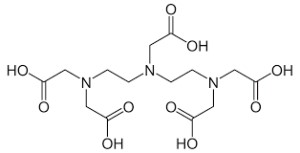
.DTPA (Diethylene triaminepenta acetic acid): Used mainly for alkaline soils. It forms 5 bonding sites with the target element, making the complex stronger than EDTA. DTPA is more effective in soils with a pH below 6.5, though it is more expensive, has lower solubility, and may be used less often due to the presence of sodium.
.EDDHA (ethylenediamine-N,N’-bis(2-hydroxyphenylacetic acid)): A superior and more expensive option, forming a complex using 6 bonding sites. For soils with a pH above 6.5 and up to 10, the use of “red iron” fertilizer (iron chelated with EDDHA) is recommended for soil application. Among its isomers, the ortho-ortho structure is the most stable. For soils with high pH, it is better to purchase fertilizers with a high percentage of ortho-ortho, while for lower pH soils, lower percentages can be more cost-effective. Experiments on carnation plants showed that EDDHA-based fertilizers demonstrated higher efficiency in absorbing iron and zinc compared to EDTA and DTPA.
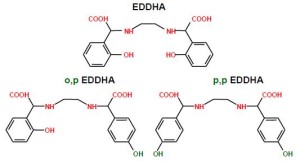
.EDDHSA Chelate: One of the most effective options available, suitable for foliar application, fertigation, and hydroponic systems. It is effective at high pH levels, ranging from 4 to 14. With solubility three times greater than that of EDDHA and EDDHMA, it is easier to use. Experiments have shown that the stability of EDDHSA is slightly superior to that of EDDHA, and it is equally powerful in restoring green color to chlorotic leaves.
. GCG (L-5-glutamyl-L-cysteinylglycine).
. NTTA (Nitrilotris (methylene) triphosphonic acid).
. TMDTA (Tri-methylene dinitrilotetraacetic acid).
- Organic Chelates:
.There are a number of natural products used as chelating agents:
. Formic acid.
. Succinic acid.
. Oxalic acid.
. Citric acid.
. Acetic acid.
. Humic acid.
. Fulvic acids and other organic acid.
.Glycine, Cysteine.
.Lignosulfonates, phenols and poly flavonoid chelates are produced using fermented by-products
How does a Chelate Work?
- In Soil:
. Positively charged metal ions, such as Zn2+, Mn2+, Cu2+ and Fe2+, readily react with negatively
charged hydroxide ions (OH-), making them unavailable to plants. Negative ions are abundant in
alkaline or neutral soils and soil-less media.
. The Chelator (a molecule that binds to a central metal atom) coats the metal ion, protecting it
from the surrounding OH- ions. The complex can then be easily absorbed by the plant, where it is
being degraded and consumed as micronutrients.
- In Plant:
. The chelation process transforms positive charge from the micro nutrients to neutral or slightly
negatively charged chelates to slide through the pores on the leaf and root surface more rapidly.
. Since these pores are negatively charged, positively charged micro nutrients would normally be
‘fixed’ at the pore entrance would be difficult to be assimilated by plants. When neutral chelated
micronutrients are used there would be no such restriction barriers.
The organic coating around the chelated nutrient allows it to penetrate through the wax into the leaf
Which iron chelate fertilizer is more suitable for you?
Iron chelates are available in several types, each with its own specific characteristics. The most important difference lies in their strength and, consequently, the stability of the chelate. Chelate strength is highly dependent on the pH level of the soil solution. Since different pH values may exist in the root environment, we recommend different iron chelates depending on your soil conditions.
The stability index of iron chelates is very important in selecting the right iron chelate. If an iron chelate is not stable, it will not be strong enough to keep the iron in solution until it reaches the plant, and as a result the iron will quickly precipitate, making it unavailable for plant uptake. Iron that precipitates due to an unsuitable pH level is converted into Fe³⁺, is said to be oxidized, and is no longer absorbable.
When choosing the right type of iron chelate for your plants, pay attention to the soil pH. In most regions of the country where soils are alkaline, the use of EDDHA iron chelate fertilizer as a soil application is recommended.
ALMENDO EMERAL fertilizer contains 6.8% iron as EDDHA chelate with 3.5% ortho-ortho isomer, and it is an excellent choice for all regions of the country, providing the iron your plants need as quickly as possible.
ALMENDO REDFER fertilizer contains 6% iron as EDDHA chelate with 4.8% ortho-ortho isomer, and it can be used safely in all regions of the country with soil pH ranging from 3 to 10.
ALMENDO FERO fertilizer is a new product containing 6% iron as EDDHSA chelate and 3.8% ortho-ortho isomer. It can be used in all regions of the country with pH between 4 and 14, and it is especially a reliable and effective choice for highly alkaline soils.
In gardening, four types of chelated iron are used:
| Chelated Type | Solubility Range (pH) |
| EDTA | 3-6 |
| DTPA | 3-6.5 |
| EDDHA | 3-10 |
| EDDHSA | 4-14 |